
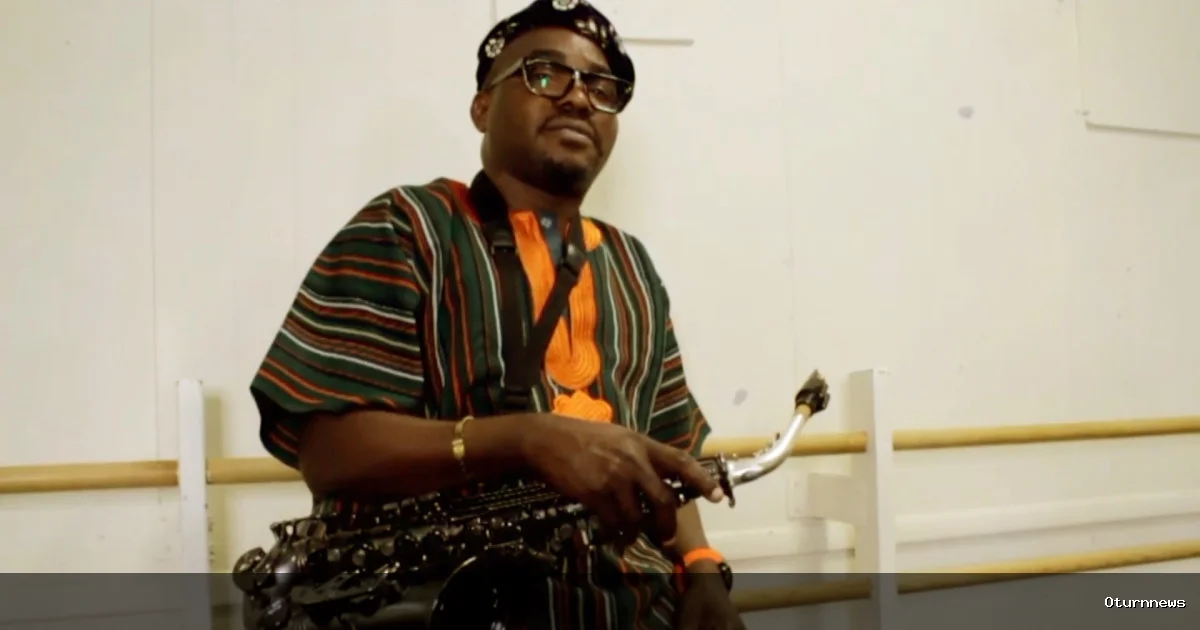
In a global music industry increasingly shaped by algorithms, trends, and the relentless chase for viral moments, Alani Nightingale stands as something genuinely rare: an artist whose sound belongs entirely to himself, whose music cannot be easily boxed, labelled, or compared to anyone else walking on any stage in the world today. He does not chase what is popular. He builds what is true. And what he has built over more than three decades of musical dedication is one of the most distinctive and compelling bodies of work in the African music diaspora.
This is the story of Alani Nightingale. Not just where he comes from but where he is going, what drives him, what his music says about culture and identity and the human spirit, and why his name deserves to be spoken in the same breath as the greatest figures in the African jazz tradition.
More in Entertainment
- Gen V Season 2: Everything Amazon Prime Video Fans Need to Know About the Boys Spinoff
- Coco Jones Steals the Spotlight: Pink Dress and Courtside Glamour at Raptors-Cavs Game 7
- Funke Akindele Calls Out Air Peace Over London Flight Delay: Waited From 7am to 4pm
- Asake Releases Fourth Studio Album MNEY on May 1 2026: Full Tracklist and What to Expect
- Lateef Adedimeji and Wife Mo Bimpe Welcome Triplet Boys After Five Years of Marriage
Born Gideon Olasunkanmi Adeola: The Man Behind the Music
Alani Nightingale was born Gideon Olasunkanmi Adeola in Nigeria, carrying from birth the weight and richness of a Yoruba name that itself tells a story about ancestry, belonging, and the deep roots of a people whose culture stretches back centuries. The name Gideon Olasunkanmi Adeola holds within it the kind of meaning that Yoruba names are constructed to carry, a biographical declaration embedded in language, a statement about family and divine favour and the hopes that parents place into their children before the world has a chance to define them.
Growing up in Nigeria, the young Gideon was immersed in the soundscapes of the church from the earliest years of his conscious life. The Nigerian church is not a quiet place. It is a living, breathing musical organism where rhythm and melody are not decorative additions to worship but the very substance of how faith is expressed, communicated, and shared. It was in this environment, surrounded by congregational singing, instrumental worship, and the extraordinary rhythmic sophistication that Nigerian gospel music contains, that the future Alani Nightingale first felt the pull of music as something more than entertainment. It was a calling. It was identity. It was the beginning of everything.
A Self-Taught Musician Who Went His Own Way
What makes Alani's musical journey particularly remarkable is that he is largely self-taught. In a world where formal music education is often treated as the prerequisite for serious artistic credibility, Alani built his craft through an entirely different route: disciplined self-study, insatiable curiosity, and years of immersive engagement with music traditions from across the globe.
He did not limit himself to one school of thought or one genre's rulebook. He studied the rich history of jazz with the dedication of a scholar, absorbing its language, its structures, its improvisational philosophy, and its emotional vocabulary. He deepened his understanding of Yoruba musical traditions, learning how African rhythmic architecture functions not just as percussion but as a complete communicative system that carries meaning, history, and spiritual content simultaneously. He explored global music traditions with the open-minded curiosity of someone who genuinely believes that great music has no passport.
The result of all this self-directed learning was not a dilettante who dabbled in multiple genres without mastering any of them. The result was a musician with an unusually complete understanding of how different musical traditions relate to each other, where they overlap, where they diverge, and most importantly, where they can be woven together in ways that create something neither tradition could produce alone.
Alongside all of this musical development, Alani also pursued academic achievement, earning a Bachelor of Science in Business Administration from the University of Ado-Ekiti in Nigeria. The discipline required to build both a serious musical practice and complete a university degree simultaneously speaks to a character trait that runs through everything Alani has done: he does not take shortcuts. He builds properly or he does not build at all.
The Sound He Created: What Is LIMUAJAZZICALS?
If you want to understand Alani Nightingale's music, the first thing you need to understand is that he has created a genre. Not adopted one, not blended two existing ones in a way that critics will file under fusion. He coined the term LIMUAJAZZICALS to describe the specific sonic territory his music occupies, and the name itself reflects the ambition and originality of what he is doing.
LIMUAJAZZICALS is the product of fusing traditional African rhythmic structures, particularly those rooted in Yoruba folklore and West African percussion traditions, with the improvisational freedom, harmonic complexity, and expressive depth of Western jazz. But describing it that simply undersells what it actually sounds like and what it actually means. The music carries the breathing, living quality of oral tradition. It moves with the organic pulse of something that grew out of community and shared experience rather than something constructed in isolation. At the same time it contains the sophisticated harmonic movement and the technical instrumental mastery that jazz demands of its serious practitioners.
The effect of hearing LIMUAJAZZICALS for the first time is the musical equivalent of recognising a feeling you have always had but never found the words for. It sounds familiar because it draws on traditions that go back thousands of years. It sounds new because no one has assembled these particular elements in quite this particular way before. It sounds human because it was built by a person who spent decades listening, learning, and being moved by music before he started making it.
His Music and Lyrics: Stories That Breathe
Alani Nightingale's compositions are not simply songs. They are narratives. They are philosophical statements. They are conversations between the ancestral and the contemporary, between the spiritual and the earthly, between the personal and the universal.
His lyrics are filled with what his official platform describes as heartfelt emotion and thought-provoking metaphors that resonate deeply with listeners. He writes about faith and resilience. He writes about the protection of forces greater than the human individual. He writes about hope as something not passive but active, not waiting to be given but claimed by those who refuse to stop believing in it.
The song "Hunter's Prayer" officially titled "Baba ma yowo loro mi" is one of the most powerful expressions of this lyrical philosophy in his catalogue. The title itself is a Yoruba phrase that speaks directly to a higher power, a plea rooted not in desperation but in relationship, the kind of prayer that comes from someone who has already established trust before the crisis arrives. The lyrics move through the Yoruba language and English with the fluency of a mind that does not experience them as separate tongues but as two entry points into the same deep reservoir of feeling.
Lines like "right here through the storm's fury, as the heavy blue wind blew through, and the voice whispers to me, with the rising sun, his promises unfold, like petals unfurling to greet the dawn" demonstrate the quality of poetic image-making that runs through Alani's writing. He does not reach for cliché. He reaches for the specific sensory detail that makes an abstract experience suddenly physical and present for the listener. The storm is not just a metaphor for difficulty. It has weight, colour, and sound. The voice does not shout. It whispers. The promise does not announce itself. It unfolds the way a flower does, slowly, inevitably, with the particular beauty of something that cannot be rushed.
The song also moves into Yoruba praise language in ways that situate the listener within a living spiritual tradition. Lines referencing the Oba, the Alagbara giga, and the imagery of royal authority and divine power reflect a Yoruba theological vocabulary that Alani wears naturally, without performance or affectation. This is not a musician appropriating spiritual language for aesthetic effect. This is a man singing from within a tradition he genuinely inhabits.
"Aja Gbeegun (Nkaan mi ni)" is another track that demonstrates Alani's ability to root a composition entirely in Yoruba cultural identity while making it musically accessible and emotionally immediate for listeners who have never heard a Yoruba syllable in their lives. The title references the Yoruba concept of Aja, a figure in Yoruba spirituality associated with the forest, healing, and wild nature, placed in dialogue with the phrase "Nkaan mi ni" which carries a possessive declaration of belonging. This is music that knows where it comes from and is proud of that knowledge.
The Tribal Invaders: Leading a Big Band With Vision
Alani Nightingale does not perform alone. He leads a big band called the Tribal Invaders, a name that itself tells a story about the relationship between tradition and conquest, between cultural identity and the willingness to enter spaces not originally designed for your sound and make them yours anyway.
The Tribal Invaders have performed at renowned jazz festivals worldwide, carrying Alani's LIMUAJAZZICALS sound to audiences across the United States and internationally. The big band format is significant because it reflects Alani's understanding of African music as fundamentally communal. The great jazz orchestras of the twentieth century understood that certain musical truths can only be expressed through the collective voice of many instruments working together under the direction of a single musical intelligence. Alani's Tribal Invaders embody that same principle while bringing it into conversation with the percussion-forward, polyrhythmic traditions of West African music.
As a multi-instrumentalist, Alani composes, arranges, records, and produces his own music, working with horns, African percussion instruments, Western continuo instruments, and his own voice across different ranges to serve his compositions. This level of creative self-sufficiency is exceptional. It means that his music from its initial conception through to its final recorded form passes entirely through his own creative vision, with no intermediate translator diluting or redirecting what he is trying to say.
From Nigeria to the United States: Relocating to Claim His Stage
In 2016 Alani Nightingale made a decision that reflected both courage and clarity of purpose. He relocated to the United States, fully embracing his identity as a performing and touring African folk jazz musician on the international stage. The move was not a departure from his Nigerian identity but an expansion of the audience for it. He was not moving away from where he came from. He was taking where he came from to where the world could hear it.
The United States has always been the global centre of jazz music, the place where the tradition was born, where it has been most seriously studied and most generously celebrated. For an African jazz musician to plant himself in that environment and not simply participate in it but contribute something genuinely new to it is a statement of artistic confidence that the quality of his work fully justifies.
Before relocating, Alani had served as a music instructor at several esteemed academic institutions across Africa, teaching African music history and performance, cultivating creativity and technical proficiency in the next generation of musicians, and helping young Africans understand the global history of jazz as something they have both inherited and contributed to. That teaching commitment reflects a person who understands music not just as personal expression but as cultural transmission, as the passing of knowledge and feeling from one generation to the next.
The African Jazz Musician of the Year Award
Alani Nightingale's contributions to the jazz community have been recognised with the prestigious African Jazz Musician of the Year award in Chicago. Chicago is not a city that awards this kind of recognition casually. The city has one of the richest jazz traditions in America, a history of musical innovation and serious appreciation that stretches back to the early decades of the twentieth century and continues with undiminished vitality today.
To be recognised by Chicago's jazz community as the African Jazz Musician of the Year is to be recognised by people who know what they are hearing. It is not a popularity contest. It is a community of serious musicians and serious listeners saying clearly that what you are doing matters, that it is adding something to the tradition, that it belongs in the conversation.
Why Alani Nightingale Matters Now More Than Ever
There is a conversation happening in global music right now about the relationship between African musical traditions and the broader international music industry. Artists from Burna Boy to Wizkid to Femi Kuti to Hugh Masekela in his time have each contributed to the growing recognition that Africa is not simply a recipient of Western musical influence but one of its foundational sources, a continent whose rhythmic, melodic, and harmonic sophistication has shaped the music of the entire world in ways that are often uncredited and poorly understood.
Into this conversation, Alani Nightingale brings something specific and irreplaceable. He brings the Yoruba folk tradition into direct dialogue with jazz improvisation. He brings three decades of dedicated craft into contact with the global stage. He brings lyrics that refuse to flatten African spirituality into decoration and instead treat it as the serious, complex, beautiful thing it has always been. He brings a musical genre he created himself because the existing genres were not big enough to hold what he needed to say.
Whether you are a lifelong jazz listener hearing African rhythmic structures for the first time, or a Yoruba speaker hearing your language carried into musical spaces it has rarely occupied, or simply a lover of music who values authenticity and originality over trend and novelty, Alani Nightingale's music has something extraordinary to offer you.
Where to Find Alani Nightingale's Music
Alani Nightingale's music is available on all major streaming platforms including Spotify and Apple Music. His official website at alaninightingale.com provides the fullest picture of his work, his vision, and the range of music he has created across more than thirty years of artistic dedication. The official music videos for "Hunter's Prayer" and "Aja Gbeegun (Nkaan mi ni)" are available on YouTube and provide the most vivid entry point into the visual and sonic world he has constructed around his music.
To listen to Alani Nightingale is to be invited into a musical universe that does not exist anywhere else. It is built from African soil, shaped by Yoruba wisdom, animated by jazz's improvisational spirit, and offered to the world with the generosity of an artist who genuinely believes that music, when it comes from a true place, belongs to everyone who is willing to receive it.




Comments
Leave a Comment
All comments are reviewed before publishing.