
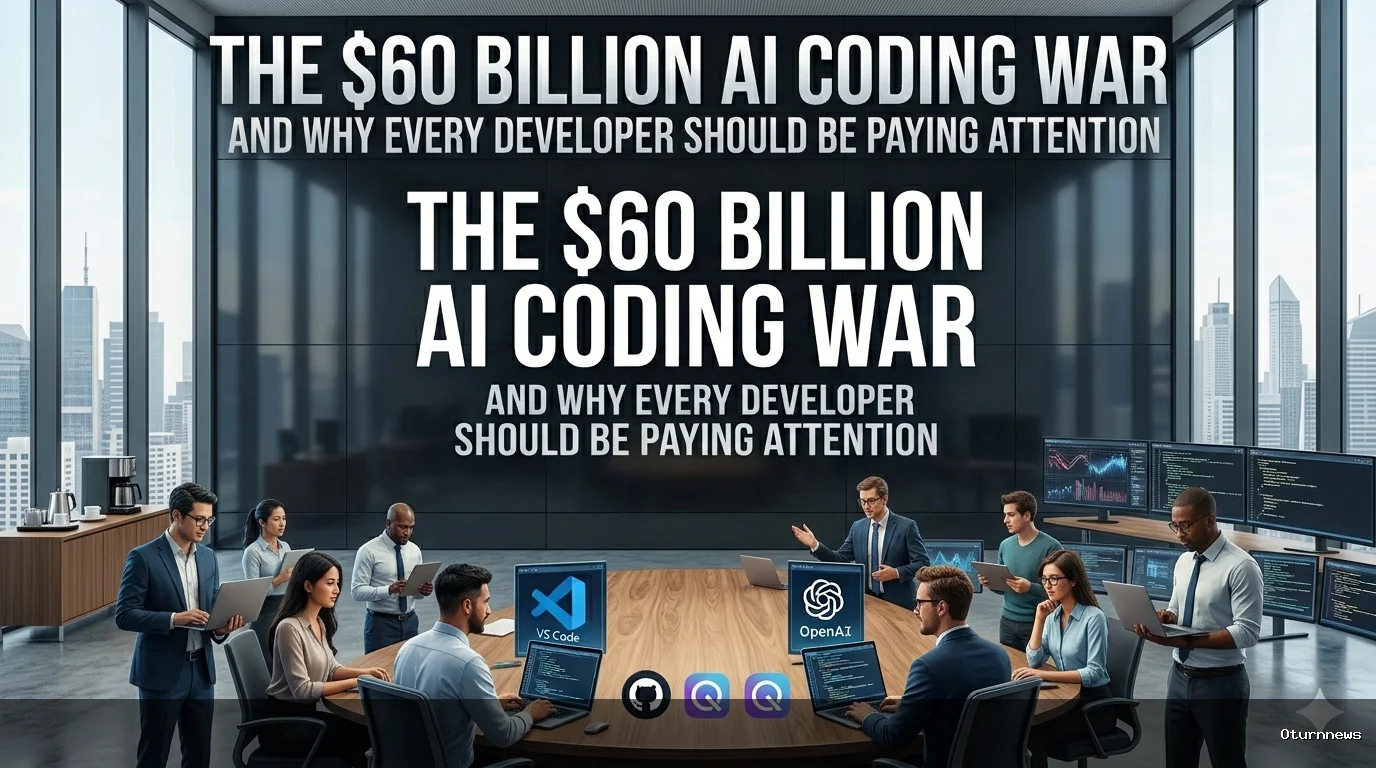
Something remarkable is happening in the world of software development, and most people outside the tech industry have not fully grasped it yet. AI coding tools, the kind that help programmers write, debug, and understand code faster, have quietly become the most valuable piece of real estate in the entire AI economy.
The numbers tell the story. A potential acquisition in the AI coding space has been valued at around $60 billion. That is not a typo. A tool that helps people write code is being valued higher than many of the world's most established banks, airlines, and manufacturers.
More in Technology
- Amazon Bets Over $33 Billion on Anthropic and Here Is What That Means for the Future of AI
- The Rise of Agentic AI: Why “Chatbots” Are Dead and “Autonomous Agents” Are the New OS
- Nigeria Is Losing N60 Billion Annually to Foreign Domain Registrations and Web Hosting Services
- PalmPay Hits 35 Million Users in Nigeria Six Years After Launch Marking Fintech Milestone
- Infinix GT 50 Pro Launches: Full Specs, Nigeria Price and Everything Gamers Need to Know
Why is AI coding worth so much money? The answer lies in where value is created in the modern economy. Software development sits at the center of virtually every industry. Banks, hospitals, logistics companies, entertainment platforms, and governments all run on code. If you can make the process of writing that code faster, cheaper, and more reliable, you are touching every single one of those industries at once.
The current generation of AI coding assistants has already proven that this is not a theoretical benefit. Developers using tools like Claude, GitHub Copilot, and Cursor report meaningful improvements in their speed and output quality. Tasks that used to take hours can now take minutes. Junior developers can handle work that previously required senior expertise. Teams can build and ship products at a pace that was not possible just a few years ago.
But we are still in the early innings of what this technology can do. The next phase is moving from tools that assist developers to tools that can work alongside them as true collaborators. Imagine describing a feature you want in plain language and having an AI system write the code, test it, catch potential bugs, suggest improvements, and document everything automatically. That is the direction this technology is heading.
This is exactly why companies are willing to spend tens of billions of dollars to control this space. Whoever owns the coding assistant that developers trust and rely on daily will have access to an extraordinary amount of leverage over the software industry.
For developers, the practical advice is straightforward. Experiment with the tools that are available today. Claude, Cursor, and similar platforms are already capable of delivering real productivity gains. Get comfortable using them now, because the developers who master AI-assisted workflows today will have a significant advantage in the job market tomorrow.
There is also an important conversation happening about what this means for software engineering as a career. Some worry that AI coding tools will reduce the demand for human developers. A more nuanced view suggests the opposite is likely. By lowering the barrier to building software, AI coding tools are likely to expand the overall market. More ideas will become products, more small businesses will be able to build custom software, and more problems will be solved through technology. The demand for skilled developers who understand how to direct, review, and improve AI-generated code is likely to grow, not shrink.
The race to dominate AI coding is one of the most consequential technology battles of this decade. Whether you write code for a living, manage software teams, or simply use apps and digital products in your daily life, this competition will affect you. The winners will have enormous influence over how software gets built, and by extension, how the digital world around us continues to evolve.



Comments
Leave a Comment
All comments are reviewed before publishing.