
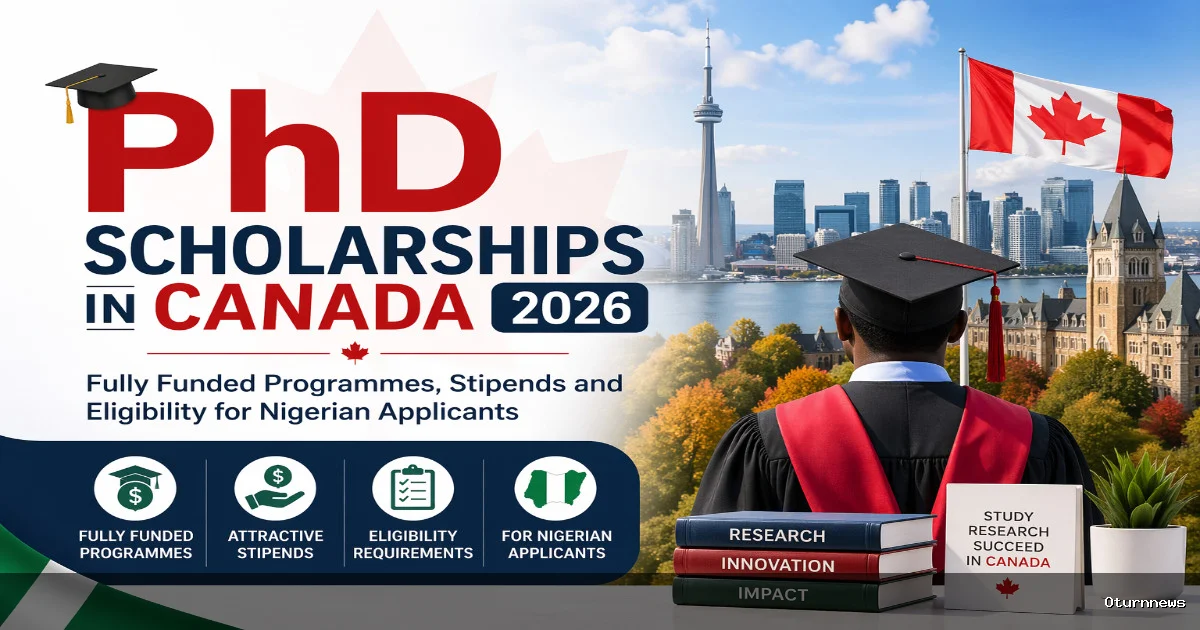
Completing a PhD in Canada is a world-class achievement that opens doors to academic positions, research leadership roles, and senior professional careers on every continent. For Nigerian scholars with strong research backgrounds and a desire to contribute to global knowledge, a Canadian PhD represents one of the most rewarding and accessible paths to international academic distinction. And in 2026, the funding landscape for PhD study in Canada is genuinely favourable to well-prepared international applicants including Nigerians.
How PhD Funding Works in Canadian Universities
Understanding how Canadian PhD funding works is essential before you begin your application because it is structured very differently from the UK or the US systems. In Canada, the expectation at research-intensive universities is that every admitted PhD student will receive funding for the duration of their programme, typically four to five years. This funding comes from a combination of sources: the supervisor's research grant, university fellowships, teaching assistantships, and competitive government scholarships like Vanier.
More in Scholarships
- How to Apply for Canadian Scholarships 2026: Complete Beginner's Guide for Nigerian Students From Start to Finish
- Fully Funded Canada Scholarships 2026 for International Students: Every Major Programme Explained
- Masters Scholarships in the UK 2026 with Full Funding: Top Universities, Courses and Application Guide for Nigerians
- UK Scholarships 2026 for Low GPA Students: Which Awards Accept Second Class Lower and Below
- UK Scholarships 2026 for Nigerian Students: Full List, Requirements, Deadlines and How to Apply
The result is that most Canadian PhD students in STEM fields and many in social sciences and humanities receive a combination of sources that together provide approximately twenty thousand to thirty thousand Canadian dollars per year in funding. This is not always a single named scholarship. It is often a package assembled from multiple sources by your supervisor and department. When you are evaluating PhD offers from Canadian universities, always ask for a full breakdown of the funding package being offered, not just the headline number.
Top PhD Scholarships in Canada for Nigerian Students in 2026
Vanier Canada Graduate Scholarship
The Vanier Scholarship provides fifty thousand Canadian dollars per year for three years and is the most prestigious PhD scholarship available in Canada to international students. It is funded by the federal government through the three major research councils and is available in health research, natural sciences and engineering, and social sciences and humanities. Nigerian PhD applicants with first class academic records, research experience, and documented leadership are competitive candidates. The application is submitted through a Canadian university that nominates you, making the supervisor relationship central to the entire process.
Ontario Trillium Scholarship
The Ontario Trillium Scholarship provides forty thousand Canadian dollars per year for four years for exceptional international PhD students at Ontario universities. It is one of the most valuable provincial PhD scholarships in Canada and Nigerian applicants who meet the academic requirements are fully eligible. Applications are considered as part of the PhD admissions process at participating Ontario universities including the University of Toronto, Queen's University, Western University, and the University of Ottawa.
University Doctoral Fellowships
Most major Canadian universities offer their own doctoral fellowship programmes for outstanding international PhD students. The University of Toronto's Excellence Awards, McGill's internal doctoral fellowships, UBC's Graduate Fellowship, and similar programmes at other institutions provide additional funding on top of research assistantships. These are typically awarded at the point of admission and are an important part of the overall funding package you receive when you are admitted.
External Research Grants Through Your Supervisor
Many Canadian PhD supervisors hold research grants from NSERC, CIHR, or SSHRC that include funding for graduate students. When you join a supervisor's team, your stipend is often partially or fully funded through their grant. This is not a scholarship you apply for separately. It is built into the supervisor's capacity to take you on. When corresponding with potential supervisors, it is entirely appropriate to ask about their current funding situation and their capacity to support a new PhD student financially.
Fields Where Nigerian PhD Students Are Strongest in Canada
Nigerian PhD students in Canada have historically been strongest in engineering, particularly electrical, civil, and petroleum engineering. Computer science, health sciences, public health, education, business, economics, and social sciences have also produced strong cohorts of Nigerian PhD holders at Canadian universities.
Interdisciplinary research areas that address African development challenges, including food security, climate adaptation, public health systems strengthening, urban infrastructure, and financial inclusion, are particularly well-funded in Canada because they align with the research priorities of Canadian government funding bodies and international development funders with Canadian operations.
What Nigerian PhD Applicants Often Get Wrong
The most common mistake Nigerian applicants make when applying for Canadian PhD programmes is sending generic emails to dozens of supervisors without demonstrating genuine knowledge of the supervisor's specific work. Canadian academics receive many such emails and most are deleted without a response. An email that demonstrates you have read two or three of the supervisor's recent papers, understood their research questions, and can articulate a specific connection between their work and your own interests will stand out immediately and dramatically increase your chances of getting a response.
The second common mistake is applying without a clear research proposal. Unlike some other systems where the PhD topic is defined after admission, Canadian PhD applications typically require you to come with a research direction already sketched out. It does not need to be a complete proposal at the inquiry stage but you need to show you have thought seriously about the research questions you want to pursue and why this specific supervisor and institution are the right environment for that work.




Comments
Leave a Comment
All comments are reviewed before publishing.